


For managers and executives, how you dress is part of how you lead.
Leadership isn’t only what you say or decide — it’s the impression you make before you say a word. Research in organizational behavior consistently shows that people form assessments of confidence, competence, and authority within seconds of a first impression. For managers and executives, that means your wardrobe is working for you or against you every single day.
What the Research Says About Appearance and Leadership
A peer-reviewed study published in the Journal of Experimental Social Psychology established that clothing influences not just how others perceive us, but how we perceive ourselves — affecting attention, confidence, and decision-making. For managers who make high-stakes calls daily, this has real implications.
Studies consistently show that individuals dressed in formal attire are rated significantly higher on perceived competence, trustworthiness, and authority — even when observed for only a few seconds. — ResearchGate: The Influence of Clothing on First Impressions, 2015 [source]
Formal business clothing has been found to promote more abstract, big-picture thinking — the exact mode of cognition most valuable in leadership and strategic roles. — Enclothed Cognition Research / ScienceDirect, 2012 [source]
Dressing for the Role You Hold — and the One Ahead
The widely circulated piece of career advice — dress for the job you want, not the job you have — is a cliché precisely because it’s true. In a corporate environment, the way managers dress signals their understanding of the role, their respect for the context, and their aspirations.
But “polished” doesn’t mean conformist. A custom suit allows a manager to express their individual identity within a professional framework — a distinctive lapel, a subtle texture, a lining that reflects personality — without sacrificing authority.
The Dress Code Shift: Why Standing Out Matters More Now
Between 2018 and 2024, organizations enforcing formal dress codes via employee contracts dropped from 30% to just 4.3%. Today, 55.8% of employers use only non-contractual guidelines. — Brightmine / Onrec Research, 2024 [source]
In an era where almost no one is required to dress formally, the manager who chooses to — with intentionality and quality — signals something distinct. It’s no longer a compliance decision. It’s a leadership statement.
Custom Suits for Specific Management Contexts
Client-Facing Managers
For professionals in consulting, financial advisory, law, or business development, clothing is part of the service experience. Clients notice when their advisor takes presentation seriously. A custom suit signals that you operate at a high standard across everything you do.
Internal Leaders and Department Heads
Managers who lead teams internally — HR leaders, operations heads, department directors — benefit from clothing that projects approachability and authority simultaneously. A well-fitted blazer and trousers achieves this in a way that a boxy off-the-rack suit simply doesn’t.
Executives in Media and Public Roles
For managers who appear in media, represent their organization publicly, or speak at industry events, custom clothing is essentially non-negotiable. JBD Clothiers has dressed ESPN’s Scott Van Pelt and NFL coaches for exactly this reason — on camera and on stage, fit is everything.
Building a Professional Wardrobe, Not Just a Single Suit
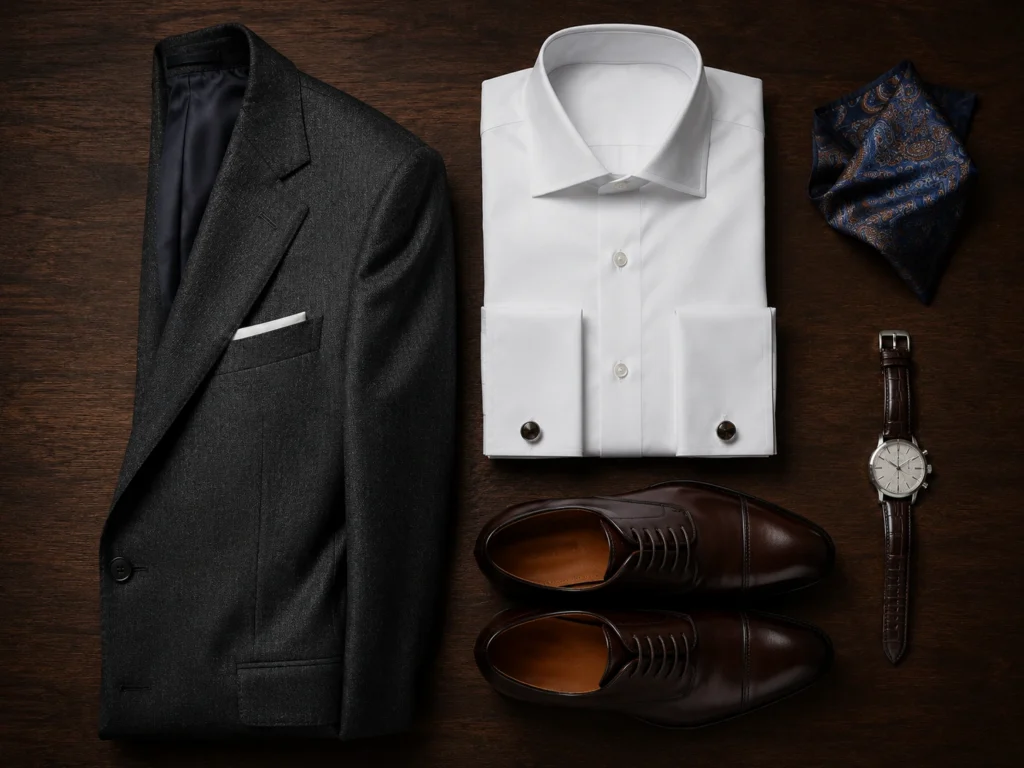
One of JBD clothiers most valuable offerings for professional clients is wardrobe consulting — the process of building a cohesive, versatile collection rather than purchasing individual pieces at random. A well-constructed professional wardrobe might include:
- Two to three core suits in navy, charcoal, and medium gray — sourced from premium European mills like Loro Piana or Vitale Barberis Canonico
- A custom blazer or sport coat for business-casual contexts
- Custom dress trousers that work across combinations
- A seasonal overcoat for northeastern and midwest climates
The U.S. menswear market is projected to reach $190 billion by 2033 — with growing demand for custom and sustainable clothing cited as a primary driver. — IMARC Group, U.S. Menswear Market Report, 2025 [source]
The Long-Term ROI of Dressing Well
The return on a custom wardrobe isn’t just aesthetic. Research on enclothed cognition has shown that people who feel well-dressed perform with greater confidence in high-stakes situations. The psychological effect of wearing clothing that fits precisely — that doesn’t bind, distract, or require adjustment — is measurable in focus and composure. For managers whose days are a series of high-stakes moments, that composure is a professional asset.
JBD Clothiers serves professionals across the United States. Request a consultation at jbdclothiers.com — and invest in the version of yourself that walks into every room ready.